
www.industry-india.com
26
'25
Written on Modified on
High-Capacity HVDC Link for Renewable Integration
GE Vernova will supply advanced HVDC technology for India’s Khavda–South Olpad transmission corridor, enabling large-scale renewable power transfer to the national grid.
www.gevernova.com
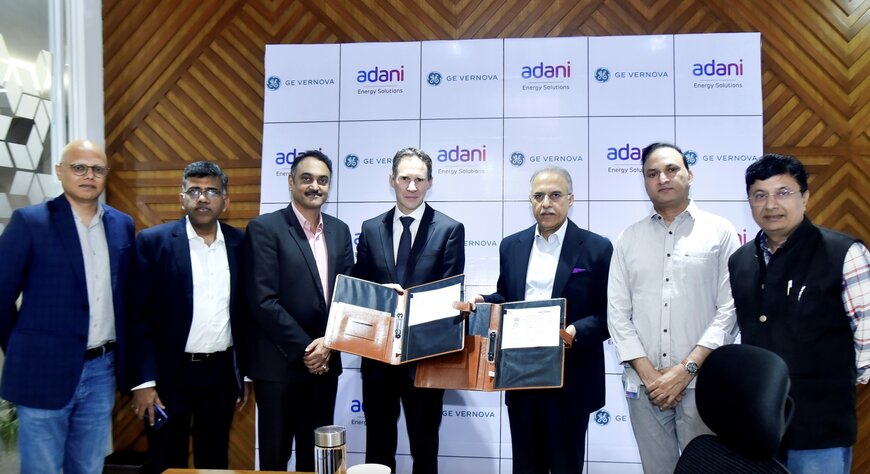
GE Vernova has been awarded a contract by Adani Energy Solutions Ltd. to deliver high-voltage direct current technology for the 2.5 GW Khavda–South Olpad renewable power transmission corridor in India.
Strategic role of the Khavda–South Olpad corridor
The Khavda–South Olpad corridor is a key element of India’s renewable energy expansion strategy. Khavda, located in Gujarat’s Kutch region, is being developed as one of the world’s largest renewable energy zones, while South Olpad functions as a major pooling and injection point into India’s national transmission network.
The corridor is designed to move large volumes of renewable electricity generated in western India efficiently and reliably into the wider grid, addressing the geographic mismatch between generation-rich regions and demand centers.
HVDC system scope and technical configuration
GE Vernova’s Electrification Systems business will supply a ±500 kV, 2,500 MW (2 × 1,250 MW) voltage-sourced converter–based bipolar HVDC system for the point-to-point transmission link. VSC-based HVDC technology is particularly suited to renewable integration due to its controllability and ability to operate with weaker grids.
The scope includes full system design, converter stations at each end of the link, supply of major converter station equipment, and responsibility for erection, testing, and commissioning activities. Civil works are excluded from GE Vernova’s scope.
Control platform and execution model
The HVDC system will be delivered using GE Vernova’s eLumina control platform, which is designed to support stable, secure, and efficient grid operations through advanced monitoring, automation, and control functions.
Execution of the project will be largely led by GE Vernova’s India-based teams, leveraging local engineering expertise and manufacturing capabilities. Delivery is planned in phases, with overall completion targeted by 2030.
Milestone for HVDC deployment in India
With a capacity of 2,500 MW, the Khavda–South Olpad project represents the highest-rated VSC-based HVDC system planned in India to date. Deployments at this scale reflect the increasing maturity of next-generation HVDC technology and its readiness to support complex, high-capacity transmission requirements.
Such projects also indicate a shift toward more controllable transmission solutions as renewable penetration increases and grid dynamics become more variable.
Supporting stability in renewable-heavy grids
VSC-based HVDC systems provide fast frequency response, precise power flow control, and the ability to support grid stability under fluctuating generation conditions. These characteristics are increasingly important in power systems with high shares of wind and solar energy.
Within India’s rapidly expanding renewable landscape, the Khavda–South Olpad HVDC corridor illustrates how advanced transmission technologies are being deployed to strengthen grid resilience, reduce losses over long distances, and enable large-scale clean energy integration.
www.gevernova.com
