
www.industry-india.com
03
'26
Written on Modified on
Industrial Scroll Compressor Manufacturing Architecture for Cold Chain Applications
Copeland expanded manufacturing in Atit to localize scroll compressor production for domestic commercial refrigeration and climate systems.
www.copeland.com
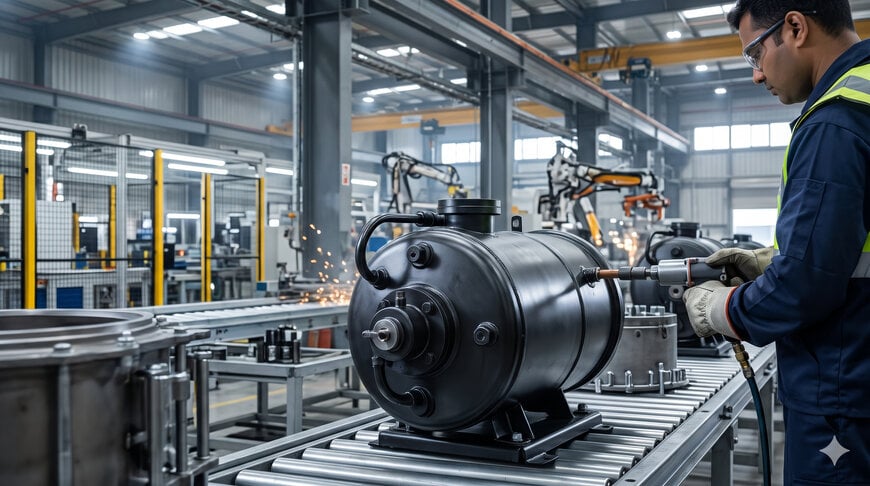
AI generated Image
Rapid expansion across India's temperature-controlled logistics and commercial cooling sectors requires reliable, hermetic compression technology capable of operating under high ambient thermal stress while reducing dependence on extended international supply chains. Addressing these domestic supply chain and efficiency demands, Copeland expanded its manufacturing facility in Atit, Maharashtra, becoming the first manufacturer to establish local production lines for scroll compressors in India.
Domestic HVACR Supply Chain and Manufacturing Infrastructure
The Indian heating, ventilation, air conditioning, and refrigeration (HVACR) market historically relied on imported scroll compressor assemblies to support commercial chillers, supermarket refrigeration racks, and rural cold storage infrastructure. Sourcing critical hermetic units from abroad exposes equipment manufacturers to extended lead times, shipping volatility, and limited customization options for domestic operating environments.
The Atit manufacturing expansion forms the operational core of a 500-crore investment initiative announced by Copeland in 2024. Production of scroll technology at the site has been active since December 2025, with localized manufacturing coordinated alongside the company's research, engineering, and innovation operations in Pune. Establishing regional precision manufacturing directly aligns with industrial supply chain localization while providing original equipment manufacturers (OEMs) with configurable, short-lead-time compression systems.
Mechanical Scroll Architecture and Variable-Speed Modulation
Scroll compressors utilize two interleaving, involute spiral scrolls—one fixed and one orbiting—to compress refrigerant vapor continuously. As the orbiting scroll moves eccentrically around the stationary scroll, suction gas is drawn into outer pockets that progressively shrink in volume as they travel toward the central discharge port.
This positive-displacement mechanism delivers distinct thermodynamic and mechanical advantages over traditional reciprocating piston compressors. Because compression occurs continuously through multiple simultaneous stages without suction or discharge valves, scroll units exhibit minimal clearance volume losses, resulting in superior volumetric efficiency and lower operating noise. The continuous mechanical contact maintains axial and radial compliance, allowing the scrolls to separate slightly under liquid floodback or debris ingestion to prevent catastrophic mechanical failure.
The Atit facility produces both fixed-speed and variable-speed scroll configurations:
- Fixed-Speed Systems: Designed for constant-load baselines in commercial cold storage and refrigerated transport, prioritizing mechanical robustness and continuous duty cycles.
- Variable-Speed Systems: Incorporate brushless permanent magnet motors managed by matched inverter drives, modulating compressor speed dynamically across wide load ranges to eliminate cyclic on-off losses and optimize seasonal energy efficiency ratios (SEER).
"India is an important strategic market for Copeland, with a strong economy and continued growth in the HVACR market," stated Ross B. Shuster, Chief Executive Officer of Copeland. "Our 500-crore investment into our India operations reflects our commitment to our local customers, building on the expertise, talent and capabilities we have in the country."
Industrial Integration Across the Cold Chain
Refrigeration systems deployed across India must handle extreme ambient temperatures exceeding 45 degrees Celsius while preserving perishable goods across rural-to-urban transport corridors. Local manufacturing encompasses applications across residential cooling, commercial food retail, and agricultural cold storage.
"Our continued investment in India supports the 'Make in India' vision and builds on the expertise of our India-based colleagues," stated Jagadish Keswani, President of India, Middle East, and Africa for Copeland. "By combining advanced engineering and innovation capabilities in Pune with expanded manufacturing in Atit, we are bringing high-efficiency technologies closer to customers and developing solutions for India and markets around the world."
The manufactured compression portfolio and supporting cold chain technologies were exhibited at the RefCold India exhibition and conference held in November.
Additional Context:
This section details technical specifications and competitive benchmarking not included in the original product announcement.
Phase One of the Atit plant expansion initiated volume deliveries with 5-horsepower hermetic scroll models, a standard capacity benchmark widely deployed in medium-temperature commercial cold storage and walk-in chillers across South Asia. Scroll compressor designs typically achieve up to 15 to 20 percent higher seasonal volumetric and isentropic efficiency compared to equivalent hermetic reciprocating compressors, which suffer from mechanical valve throttling losses and large re-expansion volumes.
Within the commercial HVACR market, Copeland scroll technology competes against offerings from Danfoss (such as the Danfoss DSH and MLZ scroll ranges), Bitzer (Orbit series), and Panasonic. While competitors primarily supply the Indian market through manufacturing hubs located in Europe, China, or Southeast Asia, Copeland's Atit operations establish domestic, end-to-end scroll machining, motor insertion, and automated hermetic shell welding within India.
The expanded manufacturing line is engineered to support low-Global Warming Potential (GWP) and transitional refrigerants, including A2L mildly flammable blends such as R-454A, R-454C, and R-32, alongside natural refrigerants where applicable. Compressor production complies with ISO 9001 quality management benchmarks, electrical safety requirements under IEC 60335-2-34, and performance rating methodologies defined by AHRI Standard 540 (Performance Rating of Positive Displacement Refrigerant Compressors and Compressor Units). Localized engineering verification is conducted in coordination with the Karad Engineering Laboratory and Pune innovation facilities, utilizing psychrometric testing chambers to validate pressure envelopes and oil return under unstable grid voltages and severe tropical ambient conditions.
Edited by Natania Lyngdoh, Induportals editor, with AI assistance.
www.copeland.com
