
www.industry-india.com
06
'26
Written on Modified on
Schaeffler India Secures First BIS License for Roller Bearings
The Maneja and Savli manufacturing plants achieve compliance with new Indian quality standards for CRB and DGBB product lines.
www.schaeffler.com
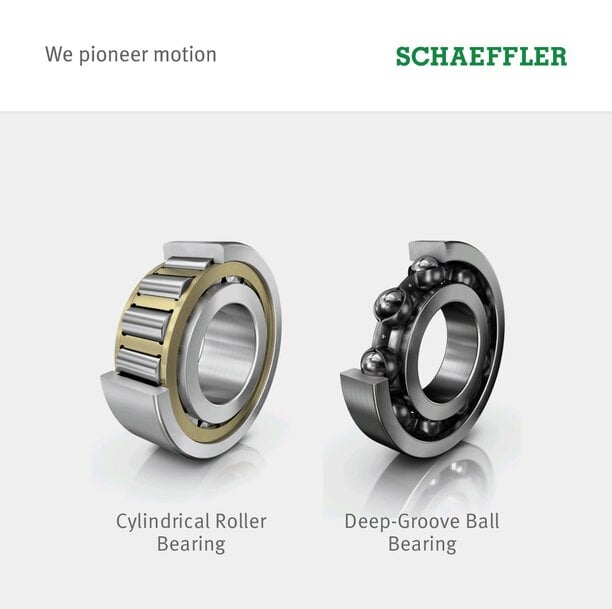
Schaeffler India Limited has become the first company in the Indian bearing industry to receive the Bureau of Indian Standards (BIS) license for Cylindrical Roller Bearings (CRB). The certification, awarded to the company's manufacturing facilities in Maneja and Savli, also covers Deep Groove Ball Bearings (DGBB). This regulatory milestone underscores the company's alignment with India's evolving industrial quality framework and reinforces the reliability of its locally manufactured product portfolio for the automotive and industrial sectors.
Regulatory Compliance and Manufacturing Standards
The BIS certification serves as a validation of adherence to standardized quality and safety protocols within the domestic manufacturing ecosystem. For the bearing industry, this compliance is critical as it ensures:
- Standardization: Products meet specified dimensions, load ratings, and material properties as defined by the new Indian standard.
- Operational Quality: The certification process audited the Maneja and Savli facilities for manufacturing consistency, quality management systems, and technical process controls.
- Market Integration: Compliance enables broader adoption of locally sourced, high-precision components in critical industrial machinery and automotive drive systems.
Strategic Significance
Achieving this license represents a shift toward more rigorous domestic oversight in the motion technology sector. By positioning its facilities to meet these new standards ahead of the industry, Schaeffler India strengthens its role as a technology partner for OEMs that require verifiable quality compliance for their supply chains. This certification also signals the company's ability to navigate changing regulatory requirements while maintaining high-volume production capabilities across multiple bearing types.
Additional Context: Engineering impact of BIS standards on bearing reliability
Bearings operate under extreme dynamic loads, and the "Indian Standard" for bearings typically aligns with international ISO benchmarks, focusing on steel purity, heat treatment homogeneity, and surface finish tolerances. The BIS certification is not merely administrative; it involves rigorous testing of bearing steel fatigue life and dimensional accuracy. For a Cylindrical Roller Bearing (CRB), the radial internal clearance and the surface roughness of both the raceways and the rollers are the primary determinants of the bearing's L10 life (the calculated fatigue life). Standards like these mandate that manufacturers implement advanced Metrology (such as 3D coordinate measuring machines and automated vibration testing) to ensure that every batch produced in Maneja and Savli meets the exact load-bearing capacity required for high-speed industrial applications. This level of verification prevents premature mechanical failure, which is the leading cause of downtime in gearboxes and industrial motors.
Edited by Lekshman Ramdas, Induportals editor – adapted by AI.
www.schaeffler.com
Achieving this license represents a shift toward more rigorous domestic oversight in the motion technology sector. By positioning its facilities to meet these new standards ahead of the industry, Schaeffler India strengthens its role as a technology partner for OEMs that require verifiable quality compliance for their supply chains. This certification also signals the company's ability to navigate changing regulatory requirements while maintaining high-volume production capabilities across multiple bearing types.
Additional Context: Engineering impact of BIS standards on bearing reliability
Bearings operate under extreme dynamic loads, and the "Indian Standard" for bearings typically aligns with international ISO benchmarks, focusing on steel purity, heat treatment homogeneity, and surface finish tolerances. The BIS certification is not merely administrative; it involves rigorous testing of bearing steel fatigue life and dimensional accuracy. For a Cylindrical Roller Bearing (CRB), the radial internal clearance and the surface roughness of both the raceways and the rollers are the primary determinants of the bearing's L10 life (the calculated fatigue life). Standards like these mandate that manufacturers implement advanced Metrology (such as 3D coordinate measuring machines and automated vibration testing) to ensure that every batch produced in Maneja and Savli meets the exact load-bearing capacity required for high-speed industrial applications. This level of verification prevents premature mechanical failure, which is the leading cause of downtime in gearboxes and industrial motors.
Edited by Lekshman Ramdas, Induportals editor – adapted by AI.
www.schaeffler.com
