
www.industry-india.com
16
'26
Written on Modified on
Data Centre Power Grid Integration Infrastructure
Tata Power Company Limited partners with data centre operators to deploy integrated power and digital infrastructure systems across industrial high-density computing clusters.
www.tatapower.com
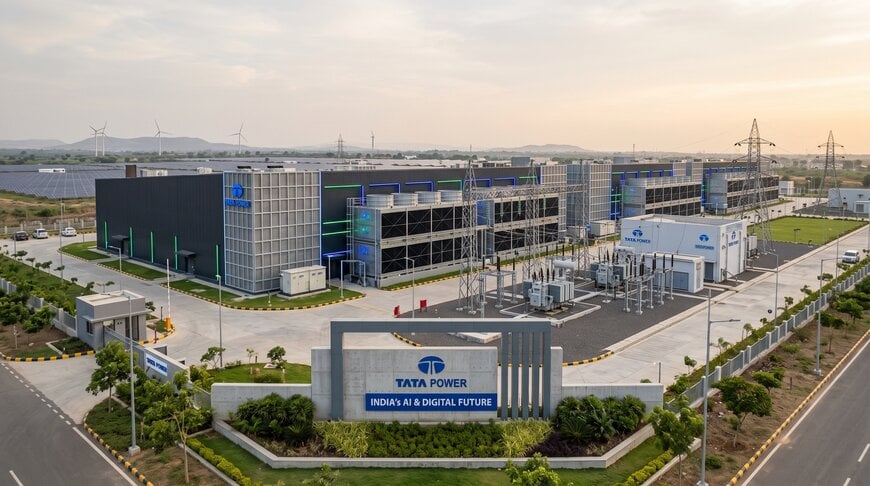
Tata Power Company Limited has established collaborative frameworks with 18 international and domestic data centre operators to implement dedicated grid connectivity, renewable generation, and power delivery infrastructure. The projects address the high-voltage electricity and thermal management demands of hyperscale computing facilities and artificial intelligence operations across industrial digital corridors.
Operational Challenge and Infrastructure Demand
Hyperscale data centers require continuous multi-megawatt base load electricity, high-voltage redundancy, and strict thermal stability. Projections from the Central Electricity Authority indicate that artificial intelligence and data infrastructure will contribute approximately 26.3 GW of added electricity demand across India by fiscal year 2031-2032.
Operating at this scale requires direct utility intervention to eliminate single-point grid failures, manage peak loads, and integrate dedicated cooling and storage systems directly at the substation interface.
Integrated Technical Solution and Partner Roles
The technical framework combines high-capacity transmission, medium-voltage distribution, and renewable generation into a unified utility architecture. Tata Power serves as the utility integration partner, engineering grid access, captive renewable supplies, and switchyard systems. The data centre operators design and manage the computational loads, internal power distribution units, and server-level liquid or air cooling systems.
The active pipeline encompasses 2.8 GW of capacity divided across functional segments: 1,236 MW linked to direct transmission access, 430 MW delivered via localized distribution networks, and 1,150 MW supplied through dedicated green energy generation. Energy storage systems and powered land packages are integrated into the facility footprints to buffer intermittent renewable supply and maintain continuous power quality.
High-Voltage Grid Implementation and Upgrades
Implementation focuses primarily on industrial nodes within the Mumbai Metropolitan Region. Engineering works involve upgrading existing 110 kV and 220 kV transmission corridors to support elevated current densities and increased transformation capacities.
To ensure continuous uptime for high-density loads, Tata Power is constructing a 400 kV bulk transmission ring network supplemented by automated receiving substations. This configuration provides dual-feed redundancy, automated busbar switching, and fault isolation, isolating computing clusters from broader regional grid disturbances.
Industrial Impact and Network Reliability
The integrated utility approach standardizes grid interconnects and substation engineering across 29 active infrastructure workstreams. By deploying a closed 400 kV transmission ring and synchronized distribution assets, the architecture minimizes transmission line losses, eliminates voltage drops during surge computing cycles, and provides the dedicated power availability required for continuous digital infrastructure operations.
Edited by Evgeny Churilov, Induportals Media - Adapted by AI.
www.tatapower.com
