
How Terafac is Rewiring Robotics with Physical Intelligence
From welding to multi-skill automation, the startup is tackling manufacturing’s biggest challenge: adaptability.
www.terafac.com
Q1: What led you to co-found Terafac, and how did your vision for “Physical Intelligence” in robotics evolve from concept to reality?
My fascination with machines started early, childhood visits to manufacturing plants with my father sparked a lifelong fascination with robots and machines. This interest translated into working as Automation Specialist for Siemens UK, and spending nearly a decade in total on manufacturing shop floors across India and Europe where I saw a 20 trillion-dollar manufacturing sector still running 72% manual, fragmented, labor-constrained, and underserved with rigid robots failing in high-mix environments. Robots were there, but mostly idle: too rigid, too costly to adapt, and unable to handle the high-mix variability that defines Indian MSMEs.
The insight was clear: automation wasn’t failing because of robots’ absence, but because of their lack of adaptability.
Meanwhile, my co-founder Amrit Singh, an IIT Delhi graduate and serial entrepreneur, brings the AI and startup DNA. From building a fashion rental company acquired by Craftsvilla to running a million-dollar tech studio and leading an AI lab, he’s used AI to push boundaries across industries.
Together, we saw the opportunity to bring intelligence to manufacturing, and Terafac was born - at the crossroads of deep industry experience and AI-first thinking.
Terafac is building a physical intelligence layer for the world’s factories, where robots don’t just execute, but perceive, adapt, and decide like skilled co-workers. Instead of forcing factories to change for automation, we envisioned a system that adapts to factories as they are.
From that vision came our first product WeldT - our first proof-point to bring intelligence to welding, one of the most skill-dependent and under-automated processes in industry.
‘Physical Intelligence is to robots what cloud was to computing, a common layer that unlocks scale.
Q2: How does Terafac’s proprietary AI-Vision platform enable robots to “see,” adapt, and make decisions without programming, and what makes this approach different from conventional automation systems?
Legacy automation breaks under variability-machines don’t connect, robots are rigid, and every change demands costly programmers. The result: high integration costs, failed pilots, and low ROI.
Factory conditions are unpredictable-parts shift, designs change, and human errors occur. Conventional automation fails in high-mix production, with skilled labor shortages and reliance on programmers compounding the problem.
Terafac flips the script. Our Software-as-a-Skill platform fuses AI-vision with robotics to create an adaptive intelligence layer. Instead of rigid pre-programmed paths, our models “see” the environment, interpret variability, and generate adaptive actions, so a robot welding or painting adjusts in real time, like an experienced craftsman.
Key enablers:
- Progressive adoption: Start with one robot, one skill, then scale across lines and plants, turning automation from a costly overhaul into a layered upgrade path.
- Factory-first design: Instead of forcing standardisation - adapts to misaligned parts, tolerance shifts, and existing hardware.
- Vendor-neutral architecture: Works across ABB, Fanuc, Yaskawa, Kuka, Panasonic, and more-freedom to scale without lock-in.
Where conventional automation breaks, our platform thrives, making scalable, intelligent automation possible for MSMEs and global OEMs across welding, gluing, and painting.
Q3: Your plug-and-play model aims to empower even small and mid-sized manufacturers. Could you share a real-world example of how this has improved flexibility, speed, or efficiency for a client?.
Robots have long been general-purpose actuators, but automation never scaled for MSMEs due to coding needs, fragmented shopfloors, and unpredictable conditions. Terafac’s AI-Vision system changes this by turning perception into motion intelligence-no coding, no upstream dependency, standalone and adaptive.
Manufacturing is diverse: a 20-person shop struggles with labour and costs, while a 2,000 robot plant struggles with scaling and consistency.
Terafac works across both ends.
- For MSMEs: Start small with one robot and one skill (welding, buffing, gluing). No programmers or heavy investment-quick ROI
- For large plants: Our vendor-neutral layer scales across brands, lines, and plants, solving variability and bottlenecks to unify automation..
We are now deploying across industries from heavy fabrication to auto-ancillaries and large OEMs. We are still early in pilots, but results are promising:
- Up to 3x productivity compared to manual welding.
- Greater consistency and reduced rework.
- Faster setup compared to programming-heavy automation.
One customer even shared that with this flexibility, they could set up a dedicated welding shop to drive additional topline revenue.
These results show potential for a fundamental change in manufacturing, delivering productivity, new business models, and wider access to intelligent automation. This is not incremental improvement but a step-change in accessibility, much like the iPhone moment for manufacturing: making sophisticated technology accessible to everyone, everywhere.
Q4: What are Terafac’s priorities for product innovation, scaling, and industry partnerships in the next 2–3 years?
Our mission is simple: bring intelligence to every corner of the shop floor.
Over the next 2–3 years, our focus is twofold:
- Scale WeldT across India, while expanding into adjacent skills like gluing, buffing, and painting, evolving into a true multi-skill intelligence layer.
- Prove adaptability at scale, with deployments across industries to demonstrate that Physical Intelligence works in diverse, high-mix environments.
On the product roadmap, we’re moving in phases:
- Robot-level intelligence - robots that perceive, adapt, and execute skills independently.
- Plant-level intelligence - connected machines coordinating downtime, quality, and production planning as a system.
Longer term, our ambition is to build an indigenous robotic foundation model tuned for manufacturing.
Strategically, we’re building partnerships with robot OEMs, power-source providers, and both component- and system-level OEMs, with conversations spanning from integration to pipeline.
Internationally, we’re preparing for expansion into the US, EU, Japan, and Dubai. The long-term play is clear: make Terafac the “operating system” of the world’s factories.
Q5: How does Terafac’s technology contribute to India’s Industry 4.0 and Make in India goals, especially in sectors where production agility is critical?
India’s biggest opportunity is not to crawl through Industry 3.0 → 4.0 slowly, but to leapfrog into Industry 5.0. Physical Intelligence makes this leap possible. The urgency is clear: the government has set a bold goal to raise manufacturing’s share of GDP from 17% to 25%, backed by $25B+ in PLI schemes.
By enabling 3x productivity, faster setup, and consistent quality, we give MSMEs the ability to scale output dramatically without being bottlenecked by the skilled labor shortage. Because our solution is adaptive and vendor-neutral, Indian factories can finally embrace automation without multi-crore CapEx overhauls.
This agility directly supports Make in India and China+1 diversification strategies: MSMEs can bid for larger, global contracts with confidence that their quality and speed match international standards. In short, Physical Intelligence helps India move from being the world’s back-office to becoming the world’s factory of choice.
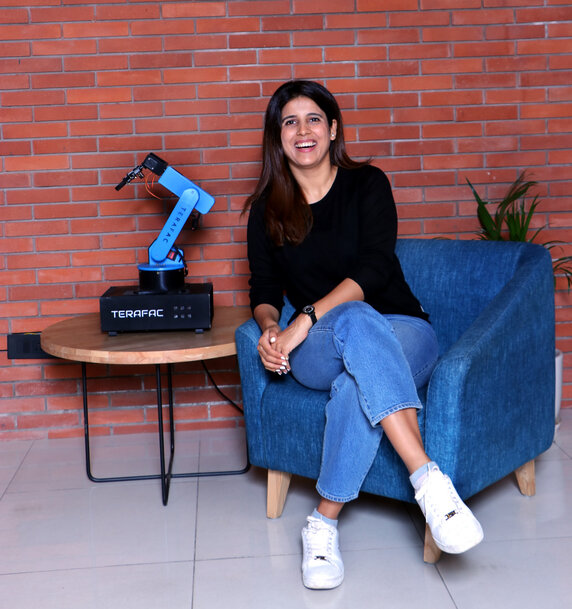
Q6: As a woman entrepreneur in deep tech and industrial robotics, what challenges have you faced, and how has building from Chandigarh influenced your journey?
My first day at Siemens, I remember walking into a workshop: the room, full of senior male engineers, looked skeptical at first. But as the time progressed, curiosity replaced doubt, and by the end, respect replaced stereotypes. Experiences like these taught me resilience and reinforced that competence is the ultimate equalizer.
Building from Chandigarh has been equally formative. Unlike metros, there’s no startup echo chamber here - no buzz to confuse with business. That absence of noise has been a gift. It forced us into raw accountability: every feature came from real customer feedback, every milestone from actual adoption. We couldn’t talk our way to relevance; we had to earn it one customer at a time.
This culture also shaped our team. People who join us here aren’t chasing perks or hype; they’re drawn by purpose. The pool may be smaller, but the commitment runs deeper.
In many ways, building from Chandigarh has been our first filter: delivering authenticity from day one.
About the Speaker
Anubhi Khandelwal is the CEO & Founder of Terafac, where she is pioneering “Physical Intelligence” in robotics to make automation adaptive and accessible. With experience as an Automation Specialist at Siemens UK and nearly a decade on global shop floors, she now leads Terafac’s mission to transform robots into intelligent co-workers for factories worldwide.
Contributed by Lekshman Ramdas
www.terafac.com
