
www.industry-india.com
01
'26
Written on Modified on
Tata Power and Keppel to Deploy CaaS Solution at Intellion Park
Tata Power Trading Company and Keppel partner with Tata Realty to implement an AI-driven Cooling-as-a-Service solution in Chennai.
www.tatapower.com
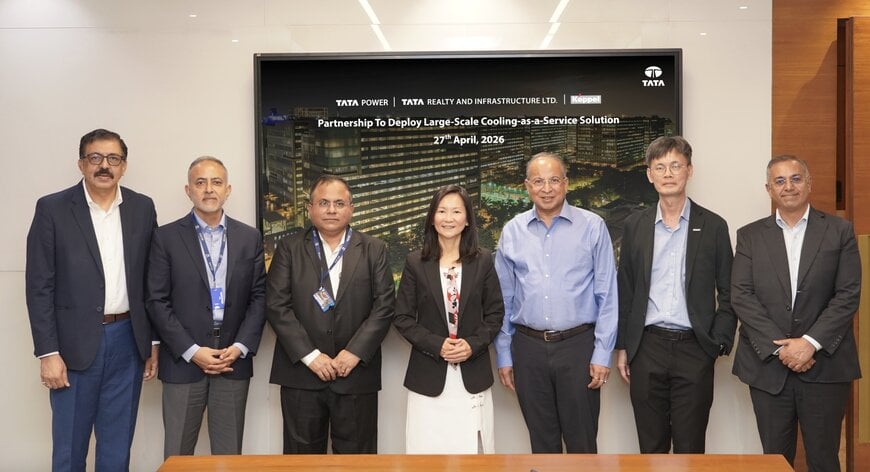
Tata Power Trading Company Limited (TPTCL), in collaboration with Keppel Limited, has partnered with Infopark Properties Limited (IPL), a unit of Tata Realty and Infrastructure Limited (TRIL), to deploy a large-scale Cooling-as-a-Service (CaaS) solution. The project will be implemented at Intellion Park in Chennai, a 25.27-acre facility located in the Taramani IT corridor.
Technical Implementation and Capacity
The project features a total installed capacity of 12,100 TR (tonnes of refrigeration) and is scheduled to commence operations in October 2026 under a 15-year contract. The system utilizes high-efficiency equipment and intelligent controls designed to reduce overall energy consumption by approximately 20%. The facility already sources green power from Tata Power, which the CaaS solution will complement to strengthen the site's low-carbon energy ecosystem.
AI-Driven Operations Nerve Centre
A central component of the solution is Keppel’s patented Operations Nerve Centre (ONC). This platform utilizes artificial intelligence (AI) and machine learning (ML) to enable:
- Real-time monitoring of cooling infrastructure performance.
- Predictive analytics to anticipate maintenance needs and system requirements.
- Dynamic performance optimization to maintain efficiency and reliability across the park.
Strategic Scalability and Efficiency
The partnership follows a service-led model that requires no upfront investment from the asset owner, focusing instead on performance-driven outcomes. Beyond the initial cooling infrastructure, the collaboration is expected to expand into the broader heating, ventilation, and air conditioning (HVAC) systems, including low-side air-handling units. Tata Power and Keppel have secured additional CaaS projects and are developing a pipeline targeting data centers, advanced manufacturing facilities, and district cooling for master-planned cities.
Additional Context
Cooling-as-a-Service (CaaS) represents a shift in infrastructure management from a Capital Expenditure (CAPEX) model to an Operating Expenditure (OPEX) model. In traditional setups, property owners are responsible for the high upfront costs, maintenance, and eventual obsolescence of cooling plants. Under CaaS, the provider retains ownership and operational responsibility, incentivizing them to maximize energy efficiency to ensure profitability.
Technically, the integration of an AI-driven Operations Nerve Centre addresses the inherent inefficiencies in large-scale cooling, where demand fluctuates significantly based on occupancy and ambient temperature. By using ML-driven predictive analytics, the system can adjust chilled water temperatures and flow rates in real-time, preventing "low delta-T syndrome"—a common inefficiency in large chilled water systems. This granular control is vital for India's commercial sector, which faces rising peak power demands and is projected by the International Energy Agency to become the world's largest consumer of space cooling by 2050.
Edited by Romila DSilva, Induportals Editor, with AI assistance.
The partnership follows a service-led model that requires no upfront investment from the asset owner, focusing instead on performance-driven outcomes. Beyond the initial cooling infrastructure, the collaboration is expected to expand into the broader heating, ventilation, and air conditioning (HVAC) systems, including low-side air-handling units. Tata Power and Keppel have secured additional CaaS projects and are developing a pipeline targeting data centers, advanced manufacturing facilities, and district cooling for master-planned cities.
Additional Context
Cooling-as-a-Service (CaaS) represents a shift in infrastructure management from a Capital Expenditure (CAPEX) model to an Operating Expenditure (OPEX) model. In traditional setups, property owners are responsible for the high upfront costs, maintenance, and eventual obsolescence of cooling plants. Under CaaS, the provider retains ownership and operational responsibility, incentivizing them to maximize energy efficiency to ensure profitability.
Technically, the integration of an AI-driven Operations Nerve Centre addresses the inherent inefficiencies in large-scale cooling, where demand fluctuates significantly based on occupancy and ambient temperature. By using ML-driven predictive analytics, the system can adjust chilled water temperatures and flow rates in real-time, preventing "low delta-T syndrome"—a common inefficiency in large chilled water systems. This granular control is vital for India's commercial sector, which faces rising peak power demands and is projected by the International Energy Agency to become the world's largest consumer of space cooling by 2050.
Edited by Romila DSilva, Induportals Editor, with AI assistance.
